
Laryngeal Cleft Symptoms Diagnosis Treatment FAQs Definitions
What Is a Laryngeal Cleft?
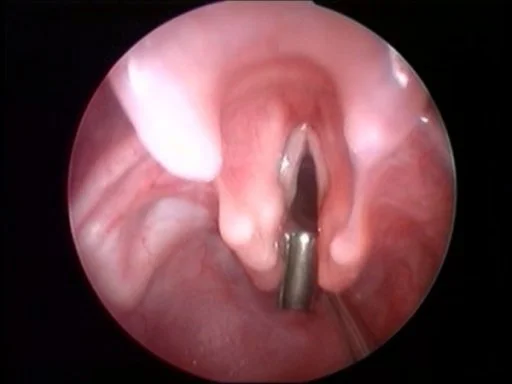
In normal anatomy, tissue separates the larynx from the esophagus. This separation helps ensure that food and liquids travel safely into the stomach through the esophagus rather than entering the airway.
When a gap is present in this tissue, swallowed substances may enter the lower airway. This is called aspiration. A laryngeal cleft can also cause a variety of other symptoms.
The Larynx

© 2020 Terese Winslow LLC, U.S. govt. has certain rights.
The larynx serves as a gatekeeper that enables the body to safely perform three essential functions: breathing, speaking, and swallowing.
Breathing: The vocal cords open to allow air to pass through the trachea and into the lungs.
Speaking: The vocal cords close and vibrate as air is expelled from the lungs through them, producing sound.
Swallowing: The vocal cords and epiglottis close to prevent food, liquids, and saliva from entering the airway. This action allows substances to pass safely through the esophagus and into the stomach without entering the airway.
Functions of the Larynx
Swallowing
Breathing

When a laryngeal cleft is present, swallowed substances may enter the airway even when the vocal cords and epiglottis close properly.
What Causes a Laryngeal Cleft?
The causes of laryngeal clefts are currently unknown. Clefts can occur randomly, as a part of a genetic syndrome, or may be inherited.
Early in normal fetal development, a single tube forms and later separates into two distinct tubes: the esophagus and the trachea. Sometimes this separation does not fully occur, resulting in a laryngeal cleft.
How Common is this Condition?
Laryngeal clefts are considered a rare congenital anomaly. Studies commonly state that laryngeal clefts occur in 1 out of every 10,000 - 20,000 live births, affecting more boys than girls.
However, more recent studies have found type 1 laryngeal clefts are more common than previously thought. More research is needed to learn the true incidence rate for each type of laryngeal cleft.
The Congenital Anomalies and Research Exploration Study seeks to discover the genetic cause(s) of laryngeal clefts.
Anatomy Basics
The Larynx
The larynx is an organ located in the neck. Made of cartilage, ligaments, muscle, and mucous membranes, it’s about the size of a marble in infants and a plum in adults.
The larynx contains specialized structures, including the vocal cords and a protective flap called the epiglottis.
If you place your hand on the front of your neck and hum, you can feel the vocal cords vibrating within the larynx.
The Trachea
The trachea is a firm but flexible tube that connects the larynx to the lungs. It sits below the larynx in the lower neck and upper chest.
Its C-shaped cartilage rings help keep it open, allowing air to pass into the lungs from the nose and mouth.
The Esophagus
The esophagus is a muscular tube that is part of the digestive system. It lies behind the trachea, close to the spine, and transports food and liquids from the mouth to the stomach.
Anatomy of the Larynx

Medically reviewed in 2026 by:
Reza Rahbar, MD, DMD — Pediatric Otolaryngology, Boston Children's Hospital
Michael Rutter, MD — Pediatric Otolaryngology, Cincinnati Children’s Medical Center